Skip to Main Navigation | Skip to Page Content

By Dr. Maria Moyer
It has been almost ten years since The Richard Stockton College of New Jersey officially announced plans to move to 33 Wilson Avenue in Port Republic to establish its Marine Science and Environmental Field Station on the Nacote Creek. On December 9, 1992 the College’s Board of Trustees approved the purchase of 7.8 acres of land, at both sides of Wilson Avenue.
The property shown on Figure 1, owned in 1992 by Stockton Professor Theodore Von Bosse and his wife, had approximately two acres on the south side of the street, featuring 250 feet of waterfront with a 100 by 50 feet bulkheaded lagoon, and two buildings, namely a two-story structure and a separate workshop. Zoned as Marine Commercial in the Nacote Creek district, all boatyard and marine uses were permitted by the City of Port Republic. In fact Mr. Von Bosse and his wife operated on the site a small boatyard since 1970.
Figure 1 - Field Station Property Bought by Stockton in 1992 - Property lines are approximate
On the north side of Wilson Ave there was a residential log cabin, a garage and a little bungalow surrounded by about five acres of forested land. It wasn’t until 1997 that the 2000 square feet log cabin would be renovated, with help from a grant of the National Science Foundation, into a teaching laboratory, faculty research areas and a research greenhouse. But immediately after its acquisition, during the summer 1993, the Field Station underwent extensive renovation only at the south side of Wilson Ave., in the two-story structure, establishing a wet laboratory with an assortment of tanks in the lower floor, and staff offices on the second floor. Floating docks were installed on the Nacote Creek waterfront for the College’s research vessels and the site was opened for academic activities on September 1993. Later, on the Fall 1995, Caldwell Marine donated their services to the College dredging the lagoon and waterfront.
The Nacote Creek is a tributary to the Mullica River-Great Bay estuary, which is now one of twenty-two National Estuarine Research Reserve Systems (NERRS) created by Congress in 1972. Officially dedicated on October 25, 1997 as the Jacques Cousteau National Estuarine Research Reserve, the area is to be preserved and protected under the guidelines established by the NERRS and the New Jersey Department of Environmental Protection (NJDEP). The College with its Field Station on the Creek is one of the four major state and federal facilities in the Reserve participating actively in its research and educational programs.
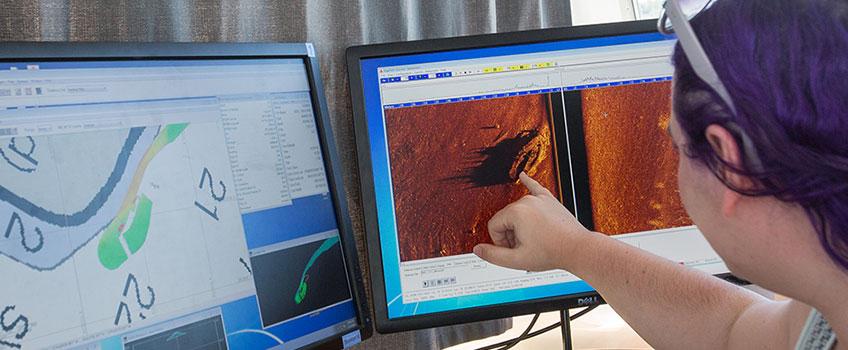
During the past ten years current technological advances were incorporated into the academic curricula at the site. Through the creation of the Evert-Moyer macro, Geographic Information Systems (GIS) were introduced in courses taught at the Field Station. The macro allows GIS neophytes with no previous training to automatically plot and map water quality measurements obtained at different points in the area, using the ArcView software program. Global Positioning Systems (GPS) are available in all research vessels, the newest of which, the R/V Osprey, is equipped with a fixed GPS unit capable of incorporating data, defined by geographic coordinates, into the GIS software. The R/V Osprey is also equipped with a 24-mile radar, a depth sounder and a davit-winch system capable of lifting over 500 lbs. In 2001 side-scan sonar was added to other resources being deployed from the vessels. Multiparameter dataloggers allow students to profile water temperature, conductivity, depth, pH, dissolved oxygen and turbidity at different locations. These units can produced real-time data or they can be left unattended collecting data for several weeks at a time. Ambient air measurements can be obtained with a Campbell Scientific Weather Station recently installed by the Creek on a 40-foot tower. In this manner, wind speed and direction, air temperature and humidity, barometric pressure, solar radiation and rainfall can be obtained as real-time averages every 15 minutes. The data will be shared with the Reserve and the community through a dedicated web page linked to the Stockton web site.
Initial concerns expressed by the neighbors in a letter to Stockton, on excessive lighting and noise among others, never materialized. Through the last ten years and the incorporated technological advances, Stockton’s presence did not change the quaint, unassuming aspect of the Nacote Creek. Students, faculty and staff go about their daily routines conducting field courses and research, on site and in the surrounding waters and the Stockton facility readily assimilated into the timeless, rustic "New England fishing village" appearance of the neighborhood, as described by its residents.
For several years, the state Department of Transportation (DOT) had planned to replace the bridge over the Nacote Creek. These plans were delayed by the intense opposition of the residents in Port Republic and Galloway Township, who saw the new bridge as having a negative impact on their businesses and properties. Besides, from an esthetical point of view, the new bridge was considered by many to be totally out of place.
When construction finally started in the year 2000, Stockton lost a 0.457-acre corner parcel to the DOT in the forthcoming realignment of Wilson Avenue. Completion of the new bridge is now anticipated by the spring 2003, when the lights and noise of progress will certainly arrive to the quiet neighborhood. A 25-foot tall fixed-span concrete bridge with two 12-foot lanes and 10-foot shoulders at both sides will be replacing the historic wooden drawbridge on Route 9 that since the 1920’s blended so neatly with the wood docks and tidal salt marshes in the area.
Looking back into the very beginnings of the old drawbridge over the Nacote Creek and the area’s development in the 1920’s, one of the first structures built on the wetlands meadows, one lot from the bridge, was a boathouse owned by Harry Barstow, father of a long time Stockton trustee: Mrs. Elizabeth Alton. According to a letter written by Mrs. Alton the boathouse "raised high on pilings had room for small boats underneath but it had no water, no heat, no electricity and no cesspool. There were no houses, no bushes, no trees, no anything on either side of the Creek from the bridge to Port Republic."
Figures 2 and 3 show the Barstow Boathouse then (Figure 2) and today (Figure 3) under a new owner, showing Route 9 as it looked in the 20’s and presently, under construction of the new bridge in 2002.
Figure 2 - Barstow Boathouse Built in the 1920's - Route 9 can be seen on left - Barstow boats
Santa Rita and Mathilde (right) moored in front
Figure 3 - Barstow Boathouse in 2002 Under New Owner - Route 9 and New Bridge
under Construction on Left
Boats navigating the waters of the creek in the 20’s were likely to look like the Barstow’s boats shown moored in the waterfront of their boathouse: 45 ft Santa Rita and 50 ft Mathilde. "We almost lived on Great Bay when fishing was so good the fish practically jumped on the boat" says Mrs. Alton in her letter. Later on, after the war, the Barstow fleet increased with the acquisition of the 106 ft Allegra shown on Figure 4.
Figure 4 - Barstow Boathouse and Boats in 1944-1945 - New Boat: Allegra
The 106-foot Allegra was a boat originally given by Walter Annenberg, the owner of the Philadelphia Inquirer, to the US government to be used in the war. Harry Barstow bought it at a public auction for $3,000. It had two staterooms, a salon with a piano near the stern and dining on the forward deck with a dumbwaiter, which pulled food up from the galley below. According to Mrs. Alton: "it was towed from Philadelphia by Westcoat up the Creek It was a big day when the bridge opened on Route 9 for the yatch. Clubs held oyster suppers and fish fries for charitable events."
By then a third house on that side of the bridge had been built next to the Barstow boathouse, as shown in Figure 4. According to Mrs. Alton s second structure, built before that one, was Dave Taylor’s across the Creek. During the late 30’s or so two priests from the Philadelphia area were the first ones to buy land after Harry Barstow on that side of the Creek. This property was the one later bought by Dave Taylor.
Police kept a close watch on cars and boats in the area. During prohibition rum running up the Creek was frequent and a popular bar was on the Bay side of the Creek, plus several other boathouses on both sides of the Creek.
Figure 5 shows the 1996 aerial view of the Stockton Field Station and the original Barstow boathouse. Today, looking at the picturesque outline of the Nacote Creek shores is easy to imagine the times Mrs. Alton refers to in her letter. After all, the green meadows and tidal salt marshes are timeless as ever. Even the boathouse still looks basically the same as then, although the boats that navigate the Creek have certainly changed and, let’s not forget the biggest change of all, the new bridge.
Figure 5 -
A letter and vintage pictures sent by Mrs. Elizabeth Alton to Senior Vice-president Tantillo inspired this article that was written marking the 10th anniversary of Stockton’s presence in the area. Current pictures of the former Barstow boathouse were provided by Professor S. Farrell.
| © 2010 Richard Stockton College The Richard Stockton College of NJ, PO Box 195, Pomona, NJ 08240 609-652-1776 |