Marine Field Station (MFS)

Aerial View of Stockton University's teaching and research facility on Nacote Creek

Marine geology students explore an uninhabited barrier island

Coastal oceanography students depart for a trip aboard the R/V Petrel

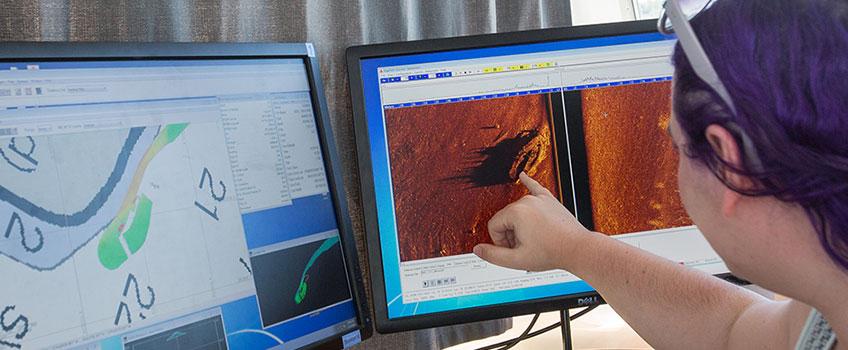
Side scan sonar images of the Pat McAlister shipwreck, pre and post-Sandy

Marine Science students utilize the latest in water monitoring instruments
The Marine Field Station (MFS) is a facility of the School of Natural Sciences and Mathematics at Stockton University and a member laboratory of the University National Oceanographic Laboratory System (UNOLS). The MFS is used as a teaching and research destination for NAMS' academic programs, including foremost the marine science program, as well as biology, environmental studies, geology, and the coastal zone management program.
The MFS in Port Republic is on an eight-acre waterfront site in the Jacques Cousteau National Estuarine Research Reserve and only 15 minutes from the Galloway campus and 30 minutes from the Atlantic City campus. The MFS makes available the facilities, research vessels, sampling equipment, and staff to provide Stockton students with hands-on learning experiences in a marine environment second to none. The MFS is also home to the University’s Coastal Research Center, a grant and contract-funded research organization focusing on many of New Jersey’s coastal zone issues. Both the MFS and the Coastal Research Center provide research and work opportunities for students.
The location of the MFS within the Mullica River-Great Bay estuary is central to its offerings; only 7 miles from the Atlantic Ocean and minutes from appropriate estuarine sites.
Stockton University values diversity and seeks to promote access to educational opportunities by providing reasonable accommodations to qualified students with disabilities to allow for participation in the University’s educational programs and activities. Information on accommodations can be found here.
News


Member of these professional organizations...


