Stockton College

Skip to Main Navigation | Skip to Page Content

Geothermal Perspective

We’ve been interested in energy conservation in buildings since the early 1970s. We studied geothermal designs in the 1980s and actually began using a geothermal system on our own campus in the early 1990s." This is Dr. Lynn F. Stiles, Professor of Physics at The Richard Stockton College of New Jersey. He is describing the background behind the installation of one of the world’s largest single closed loop geothermal HVAC systems, totaling 1,741 tons of installed geothermal heating/cooling capacity. The college in Pomona, New Jersey, now uses a large number of heat exchange wells and water source heat pump (WSHP) units to serve the heating and cooling needs of a growing campus.

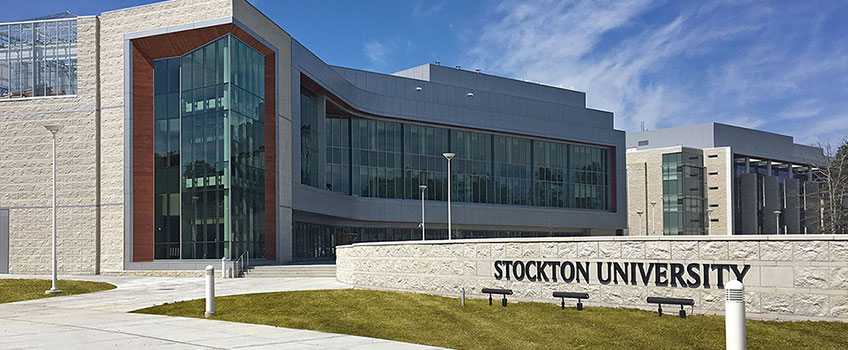
PhotoThe Richard Stockton College is an award winning, mid-sized liberal arts and sciences college. Located in the south eastern New Jersey pinelands area. Founded in 1971, today the college has an enrollment of 6,300 and annually graduates 1,500 students, nearly half of whom go on to graduate school. The school is part of the New Jersey Higher Education System and is recognized for its programs in natural sciences, physical therapy, and environmental and marine science education. Named for a New Jersey patriot and signer of the Declaration of Independence, the college is located 12 miles from Atlantic City on a rural campus that has been recognized for its harmonious fit with its pinelands surroundings.

Dr. Stiles explains that the decision to consider geothermal technology to serve the campus arose from a number of circumstances. In 1990, a new vice president, Dr. Charles Tantillo, expressed interest in reducing overhead expenses such as building heating and cooling. At the same time, the school was planning replacement of its aging fleet of multizone rooftop HVAC units-most of which dated to the school’s original construction in the early 1970s. The Director of Facilities Planning, Mr. Marvin Witmer, was a key player and was able to put the funding together.

Time to Consider New Directions
Not only was the existing plant due for replacement, but in the early 1990s the college was also building. The project design featured 400 heat exchange wells located in boreholes to a depth of 425 feet. New classroom buildings and living units for students to keep up with growing enrollment. Stiles had previously researched the merits of modern geothermal WSHP technology and urged the college to seriously consider this option. Now seemed to be the time to consider a change. The college engaged Vinokur Pace Engineering Service of Jenkintown, Pennsylvania, to perform a feasibility study of a geothermal system and to prepare designs. At the same time, the school searched for funding sources for this extensive HVAC plant improvement program. Ultimately, grants totaling $5.1 million were provided by the New Jersey State Department of Environmental Protection and Energy, New Jersey Department of Higher Education, and in the form of installation rebates from Atlantic City Electric Company. It was then possible for the college to pursue its goal of a high-efficiency geothermal system to serve most of the campus. Research grants totaling almost $1 million were obtained in order to study the environmental and energy use impacts of the project. The work done by the engineer demonstrated the feasibility of the concept and resulted in a decision to proceed. The project design featured 400 heat exchange wells located in boreholes to a depth of 425 feet. These were to be installed in a 3.5 acre area that included all of the college’s Parking Lot 1 plus some adjacent open space.

Pine Barrens a Protected Area
PhotoBecause of the protected environmental status of New Jersey’s Pine Barrens area, it was necessary for the college to get special permits from the state’s Pinelands Commission. Use of the parking lot reduced the disturbance of undeveloped land on the campus. The commission was also concerned about protection of three underground aquifers that would be crossed by the wells. According to Stiles, "Construction plans needed to demonstrate that there would be no compromise of ground water and that the aquifers would continue to be sealed from interchange with each other and with surface water." The college’s decision to use only pure water (without glycol) as the heat exchange medium also helped assuage the commission’s concerns. The commission assisted the project by expediting the permitting
process.

Stockton College parking lot plays a major part in loop system design.
PhotoHeatec, Inc., of western Pennsylvania developed the final design and, with Alderson Engineering as a subcontractor, installed the ground loop system and external horizontal piping. Approximately four feet of surface soil was removed from the loop area and stockpiled before starting the drilling and trenching operations. After completion, the area was returned to its use as a large parking lot. The wells were located on a grid and spaced roughly 15 feet apart. This work was done by a group of local well drillers. The boreholes were four inches in diameter.

Plastic Pipes Slide into Boreholes
PhotoWithin the four inch borehole, the installers placed two 1.25 inch high density polyethylene pipes with a U-shaped close-return coupling at the bottom. Installation of the pipes was complicated by the fact that the boreholes filled with groundwater and the pipes were buoyed upward. Installers overcame this problem by attaching weights to each loop and filling the heat exchange pipes with water.
After the pipes were installed in the boreholes, the holes were backfilled with a bentonite clay slurry to seal them and to enhance heat exchange. In total, the loop system comprises 64 miles of heat exchange pipe. In addition, 18 observation wells were located throughout and around the well field for long-term observation of ground water conditions.The individual wells were connected to 20 four inch diameter lateral supply and reverse return pipes using a thermal butt fusion technique. These laterals, in turn, run to a building at the edge of the field where they are manifolded into 16 inch primary supply and return lines. These primary lines go to a pump house containing two 125 hp variable speed pumps that pressurize the supply and return systems in the manifold house. In the heating mode, the loop serves as a heat source and, in the cooling mode, as a heat sink. The borehole field has a volume of 1.2 million cubic meters or, in mass, is equivalent to the heat capacity of about the same volume of water.

Trane Rooftop WSHP Units Selected
From the pump house, water is distributed through six secondary loops to 62 Trane rooftop water source heat pump units, Model WPUD, located throughout the campus. The units range in size from 10 to 35 tons and total 1,480 tons in capacity. Because the previous system had utilized multizone units, it was necessary to add 500 Trane VariTraneT"" variable air volume (VAV) boxes at the conditioned air distribution points to meet zone level requirements with the new system. All of the rooftop units are equipped for air economizer operation. The contractor for the mechanical plant work was lannacone Construction Company of Berlin, New Jersey.

The pumps, rooftop units, economizers, and VAV boxes are controlled by a Trane Tracer SummitT" building management system using 3,500 data points. The DDC control system allows the college to take advantage of comfort and energy saving options such as duty cycling, night setback, time of day scheduling, and VAV box control. The Tracer Summit system also assists in identifying maintenance needs in the system, from the loop system to the points of conditioned.

In addition to the 400 heat exchange wells, there are 18 observation wells in the parking lot.

The system changeover took place during the inter session period in the winter of 1993-1994. The startup was relatively uneventful and the system immediately demonstrated that it could carry the entire planned heating load. In the first few years of operation, the average temperature of the well field has drifted upward by several degrees. It now appears to have stabilized. This occurred because the cooling load annually releases more thermal energy to the ground than the heating load requires. Even in the cooler winter months, the system often operates with some units heating while others are in the cooling mode.

Energy Savings Meet Estimates
According to Stiles, the original estimate was that the geothermal heat pump system would reduce the school’s electric consumption by 25 percent and natural gas consumption by 70 percent. "Because of the constant changes and additions to the system, and other energy conservation steps, it is difficult to verify energy savings exactly. Based on an extensive monitoring study, they turned out to be quite accurate." "Additionally there are the savings in fuel resources for heating and, on the cooling side, the more efficient use of electricity."

The 20 lateral supply and return pipes are manifolded into I6 inch line. Stiles indicates that the project has now passed the economic payback point and that the decision was more than justified. He points out that, in addition to the dollar savings achieved with the geothermal system, significant environmental and energy conservation benefits have accrued.

Alice Gitchell from the college’s Natural Sciences and Mathematics staff is actively involved in studying and sharing information on the geothermal project and this type of technology in general. She notes that the project has substantially contributed to a calculated 13 percent overall reduction in the college’s CO, emissions during a period of significant growth on the campus. "Additionally there are the savings in fuel resources for heating and, on the cooling side, the more efficient use of electricity." Gitchell points out that in today’s environment of rising energy prices, the benefits of geothermal systems are increasingly important.

Because of its size and design, the geothermal system has made the campus a destination for many visitors/engineers and prospective owners from around the world. Gitchell says, "We’ve had visitors from all over the world. China, Japan, Korea, Sweden, Germany, France, England, almost everywhere you can name." In addition, college staff members and engineers have given numerous presentations to professional groups and geothermal conferences.

The geothermal system was built with some additional loop capacity to allow for campus additions. For example, the Arts and Sciences Building completed in 1995 also uses the system to obtain another 261 tons of cooling capacity. Instead of using rooftop heat pumps, like the other campus buildings, this building uses packaged horizontal ceiling units. On another part of the campus, nine new housing units completed in 1999 are equipped with four wells per building. The wells supply three console WSHP units per building for both heating and cooling. Advice Offered to Other Owners Because of the extended history of the project, Stiles is frequently asked for advice by others contemplating geothermal solutions. "Sizing the system right is very important. For that reason, you need buildings with well executed shells and the heat loss and gain estimates need to be accurate." Stiles also points to the importance of having access to the loop water and heat pump systems. "Heat pump units and the water pumps need to be accessible for inspection, cleaning, and repair."

Stiles suggests that owners consider incorporating a cooling tower either a wet or dry model-to precondition the well field in the winter months for cooling later in the summer. "For situations like ours, where cooling hours significantly outweigh heating hours, a cooling tower could add even more to system efficiency or capacity. That’s something we didn’t include in our original plans, but today I would."

Finally, he notes that there are numerous technical support assets that should be used. "It is critically important to have a good design and good implementation. Make sure that the engineer gets all the support needed to understand geothermal technology and design. That’s the single most important thing."


Stockton Home pageVisitorsAdmissions OfficeAcademic AffairsSearch StocktonStockton Site Map